Real Assets
We build future energy systems and resilient infrastructure, backing emerging opportunities in technology, land and water.


VCT investors broadly fall into two camps: existing shareholders, many of whom have subscribed across multiple tax years, and those with no VCT holdings at all. With upfront income tax relief now 20% rather than 30%1, advisers need to think carefully about how allocations should differ for each.
Diversification has always mattered in VCT portfolios. Generalist managers often share similar investment criteria, so the most exciting companies attract more than one deal team. It’s not uncommon to find meaningful overlap in sectors, business types and even individual companies across two or more generalist VCTs.
Lower relief may increase that risk. It is widely expected to affect fundraising, and when capital is less plentiful, managers tend to prioritise liquidity commitments to shareholders and follow-on funding for existing investee companies. The focus shifts towards existing portfolios and away from new holdings.
Since April 2026, the limits on the companies VCTs can invest in have doubled1. Managers can now back larger, better-funded businesses and support them for longer. Follow-on investment in strong performers becomes more attractive, but advisers should watch for too much value building up in one or two holdings. A write-down in a large position would have a marked effect on net asset value (NAV).
Combined with a less forgiving risk and reward balance, this is likely to draw advisers towards established managers with stronger return profiles, larger cash reserves and a proven record in difficult markets. The irony is that a flight to quality can itself add concentration for existing clients. Strong due diligence and a clear view of what each VCT actually holds are the best defence. Advisers who can show how each holding complements the others will be better placed to explain their recommendations.
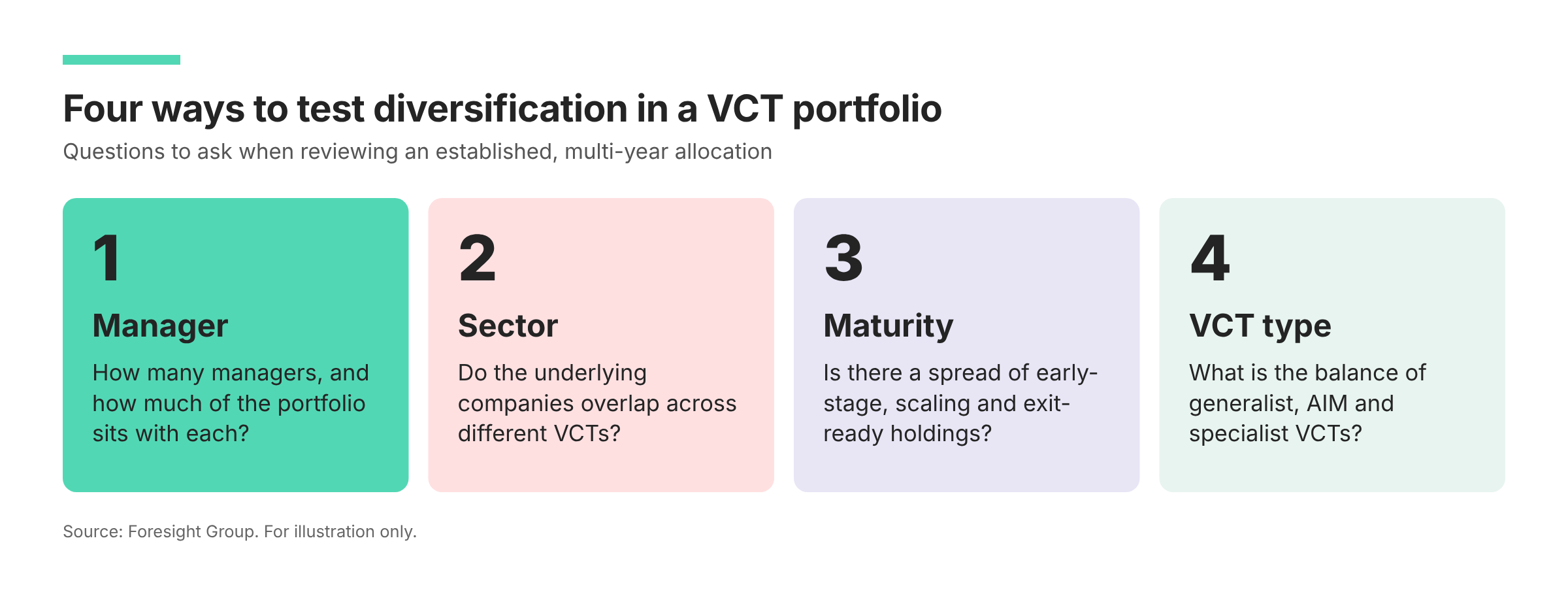
All of this points to a growing need to review multi-year portfolios, with a particular focus on manager concentration, sector exposure and dividend history. A useful starting point is to look through to the underlying companies across every VCT a client holds, then ask how much of the total sits with a single manager, in a single sector or in a handful of large positions. Cash levels and recent buyback activity are also worth checking, as both indicate how well a VCT can meet its commitments if fundraising slows.
Two practical constraints apply. Selling within five years means repaying the upfront income tax relief, and exits typically depend on the manager’s share buyback policy, with buybacks usually priced at a discount to NAV.
Where changes are recommended, advisers should keep the Consumer Duty in mind. Clients need to understand the revised strategy, how it goes beyond upfront relief, and what each new holding is intended to achieve.
Specialist VCTs have long been a way to add different sectors, growth stages or return drivers to a generalist allocation. That equation has changed. Their smaller size may make fundraising harder in current conditions, which increases the risk for investors.
They may still suit some clients, most likely those with VCT experience and a higher tolerance for risk. A broad generalist mandate can make it harder for a manager to build the depth of expertise needed to source and assess deep-tech opportunities, so the best results in those areas often come from a specialist. Two factors are worth weighing:
Holding companies at different stages of development helps to stagger exits, which can keep growth and income more regular. For a specialist VCT, portfolio maturity can be decisive. A portfolio with assets approaching an exit is less reliant on fresh fundraising to keep its companies funded, and new shareholders gain exposure to existing assets from day one. Dividends from specialist VCTs tend to follow realisations, so they are likely to be irregular and are not guaranteed.
Existing investors approaching or in retirement are generally looking for tax-free dividends to supplement their income. New investors should probably treat VCTs as a hybrid of income and growth.
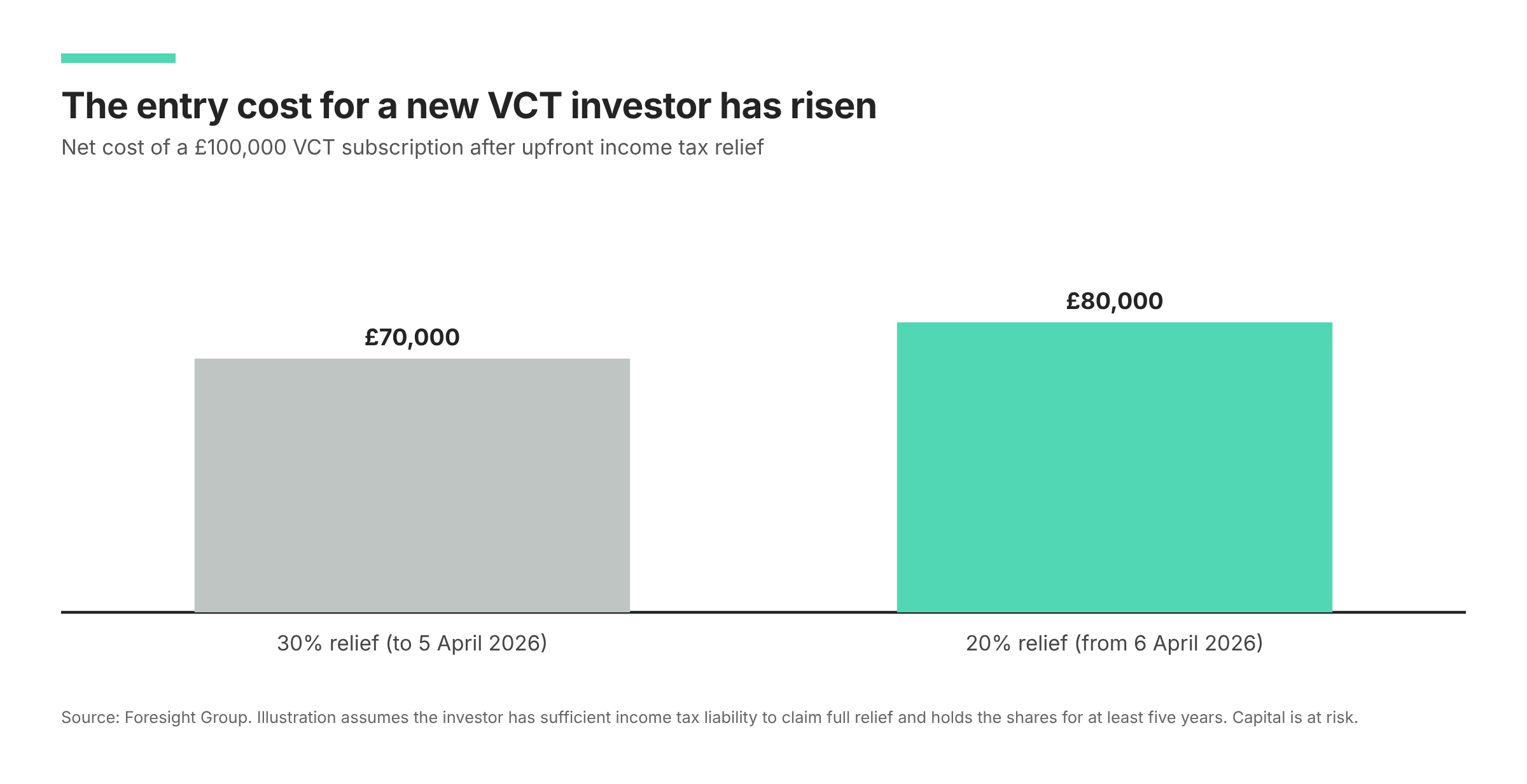
With new deal activity likely to slow, new investors may be buying into fewer early-stage companies and more mature holdings, which implies lower volatility but also less scope for exceptional gains. They will need to accept a slower pace of portfolio construction and rely more heavily on manager discipline and exit markets. Their entry cost is also higher: a £100,000 subscription now costs £80,000 after relief, rather than £70,000.
There is another way to look at it. New investors miss out on 30% relief, but they are not carrying the legacy issues, such as underperforming holdings, that long-standing investors have had to absorb over time. Building a position gradually over several tax years, and across more than one manager, remains a sensible way to manage both timing and concentration risk.
For more support on preparing clients for the changes, or to discuss how our solutions can support your planning approach, our team is ready to help. Book a meeting with your local BDM.
This article is issued by Foresight Group LLP (“Foresight”) which is authorised and regulated by the Financial Conduct Authority (“FCA”) under firm reference number 198020 on 8 October 2026. Foresight’s registered office is at The Shard, 32 London Bridge Street, London, SE1 9SG. This article has not been approved as a financial promotion for the purpose of Section 21 of the Financial Services and Markets Act 2000 (“FSMA”).
This article is intended for financial advisers and for information purposes only, and does not create any legally binding obligations on the part of Foresight. Without limitation, this article does not constitute an offer, an invitation to offer or a recommendation to engage in any investment activity. The information contained in this article is based on material we believe to be reliable. However, we do not represent that it is accurate, current, complete or error free. Assumptions, estimates and opinions contained in this document constitute our judgement as of the date of the document and are subject to change without notice. Opinions expressed by third parties are their own and do not necessarily reflect the views of Foresight.
Capital is at risk. The value of an investment, and any income from it, can fall as well as rise and investors may not get back the full amount they invest. Venture Capital Trusts (“VCTs”) should be considered longer-term investments and may be higher risk and more difficult to realise than an investment in listed securities. Investments will be made in small unquoted companies, which carry a higher risk than many other forms of investment. These investments will be illiquid and may expose you to a significant risk of losing all of the money you invest. VCTs usually trade at a discount to their net asset value.
Tax reliefs are dependent on the VCT maintaining its qualifying status and on investors’ individual circumstances. Current tax rules are subject to change. If a VCT loses its qualifying status, tax advantages will be withdrawn from that point. Foresight does not provide financial, legal, investment or tax advice. Past performance is not a guide to future performance and may not be repeated. Please see the relevant offering documents for full details where attention should be paid to the risk factors set out.