Real Assets
We build future energy systems and resilient infrastructure, backing emerging opportunities in technology, land and water.


It’s no secret that pensions will be treated like other assets for IHT from 6 April 20271. The obvious response is to reverse the strategy of the past decade, when their IHT-free status made pensions the first pot to fund and the last to draw on. But some of the more subtle effects on the rest of the estate plan risk going under the radar.
For Jamie Heffernan, Chartered Financial Planner at Progeny, “the worst part is pensions coming into the estate, bringing the estate value above £2 million, which leads to clients losing their residence nil rate band”. The allowance is worth up to £350,000 per couple and is withdrawn by £1 for every £2 of estate value above £2 million2.
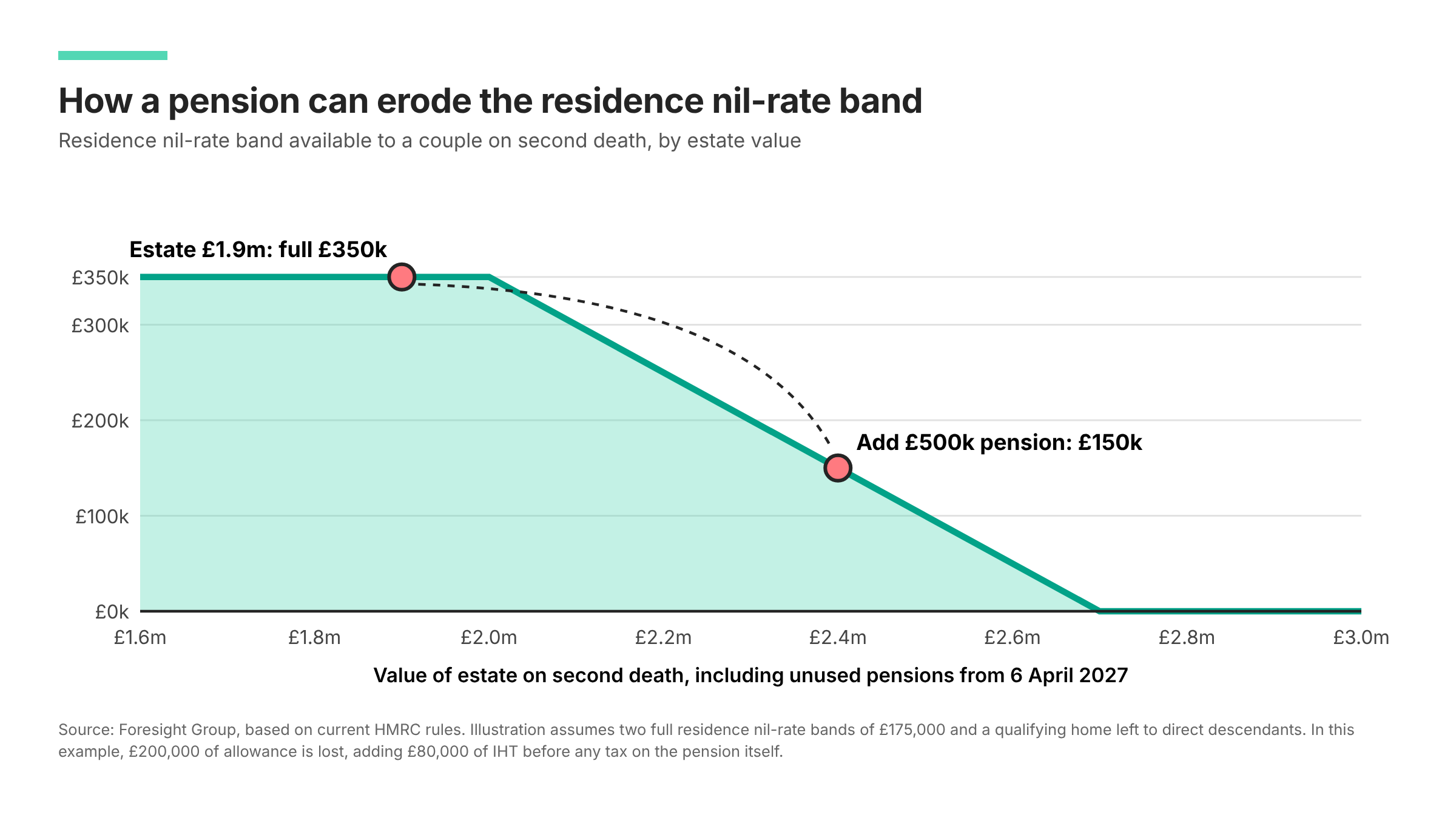
Business Relief (BR) can offer up to 100% relief after two years, but Heffernan stresses that BR-qualifying assets still count towards the £2 million test. His additional step, once the assets qualify, is to settle them into trust. Lifetime gifts are not included in the taper calculation, and where BR applies in full the transfer should not trigger the 20% lifetime charge, although the seven-year clock still runs.
BR and Agricultural Property Relief will not apply to assets held within a pension1. Many family businesses and farms hold premises or land in a SIPP or SSAS, so they could face a significant IHT bill on assets they assumed were protected. They need a plan now, which may include buying assets back out of the pension and putting alternative estate planning in place.
One of Heffernan’s clients has just turned 75. Left alone, his surplus pension would cost him the residence nil-rate band and his nieces and nephews would pay income tax on what remains after IHT. “We’re withdrawing £5,000 a month of tax-free cash and £5,000 of taxable income,” he explains. As a higher-rate taxpayer, “he’s paying the equivalent of 20% income tax to extract the funds”, and the regular pattern supports gifts from surplus income.
Paul Squirrell, Head of Retirement and Savings Development at Fidelity, warns that not every regular payment counts as income. Withdrawals of up to 5% a year from an investment bond, for example within a discounted gift trust, can be tax-efficient, “but this isn’t income. It’s return of capital.” Gifts funded this way fall under the seven-year rule.
As Squirrell puts it, “there are now going to be people who will inherit pensions without an IHT issue and those that inherit from the same pension with the creation of IHT liabilities.”
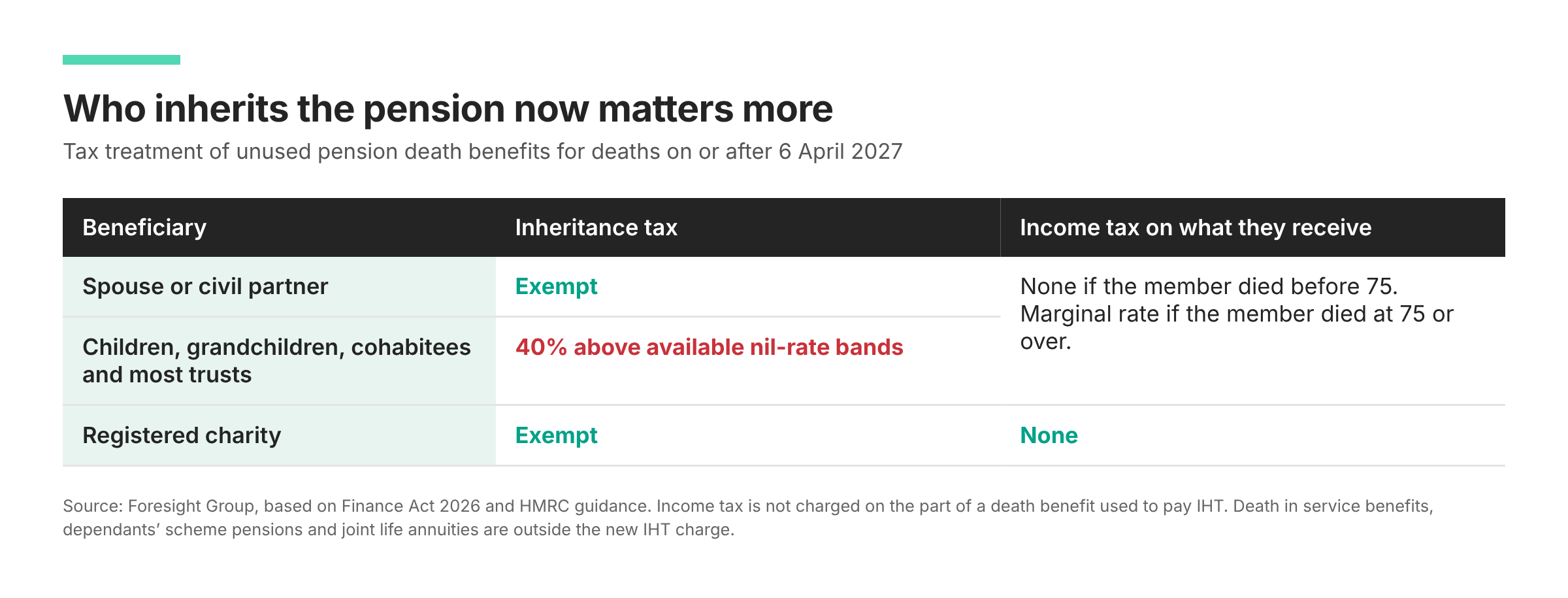
Several planning points follow:
Large gifts remove value quickly, but Heffernan finds “it’s way harder to get clients on board with large, lump sum gifts because they know they’re going to immediately lose control”. Structures such as flexible reversionary trusts, or BR-qualifying investments that remain in the client’s name, can help. Capital is at risk with BR, and whilst providers have a good record of meeting withdrawal requests, timing is not guaranteed.
Liquidity is the other concern. Personal representatives will be liable for IHT on pension assets they do not control. They can instruct the scheme to withhold up to 50% of benefits for up to 15 months, and beneficiaries can ask it to pay HMRC directly1, but property-heavy estates may still struggle. Whole-of-life cover written in trust can fund the bill, with the premiums gradually reducing the estate.
Timing matters too. Money withdrawn from a pension today enters the estate immediately, so a client who dies before 6 April 2027 could be worse off. For that reason, Heffernan is making his recommendations now but holding back sizeable withdrawals until the date has passed. Squirrell suggests that detailed letters of wishes or will codicils can help here, setting out one course of action if the client dies before the new rules take effect and another if they die afterwards.
Squirrell is clear about the priority: “Absolutely first and foremost, your pension is for funding your retirement,” he says. “There’s a danger that we focus too much on IHT and not enough on what it means in terms of planning for individuals and best outcomes.” He sees cashflow modelling as fundamental, but calls the judgement involved “not a science, but an art”.
Advisers and clients may also need to reset expectations. Reducing the effective rate is often possible. Full relief may not be. “There are so many moving parts with new legislation, personal circumstances and the IHT mitigation routes available,” says Squirrell, “so I think there’s no single silver bullet.” The answer is more likely to be a series of small, targeted steps that can be adjusted as circumstances change.
For more support on preparing clients for the changes, or to discuss how our solutions can support your planning approach, our team is ready to help. Book a meeting with your local BDM.
This article is issued by Foresight Group LLP (“Foresight”) which is authorised and regulated by the Financial Conduct Authority (“FCA”) under firm reference number 198020 on 8 October 2026. Foresight’s registered office is at The Shard, 32 London Bridge Street, London, SE1 9SG. This article has not been approved as a financial promotion for the purpose of Section 21 of the Financial Services and Markets Act 2000 (“FSMA”).
This article is intended for financial advisers and for information purposes only, and does not create any legally binding obligations on the part of Foresight. Without limitation, this article does not constitute an offer, an invitation to offer or a recommendation to engage in any investment activity. The information contained in this article is based on material we believe to be reliable. However, we do not represent that it is accurate, current, complete or error free. Assumptions, estimates and opinions contained in this document constitute our judgement as of the date of the document and are subject to change without notice. Opinions expressed by third parties are their own and do not necessarily reflect the views of Foresight.
BR products designed to manage tax liabilities are not suitable for all investors and will place investors’ capital at risk, and you may not get back the full amount invested. The tax scenarios shown are indicative and are subject to change. Please note that the availability of the BR tax reliefs is dependent on each investor’s individual circumstances. BR tax reliefs are subject to change, investments may also rely on the company or investment opportunity in question meeting BR qualifying criteria which are not guaranteed.
Foresight does not provide financial, legal, investment or tax advice, and therefore potential investors should seek specialist independent tax and financial advice before deciding to invest. Past performance should not be taken as a reliable indicator of future results and forecasted returns are not guaranteed. The BR products are long term investments and you may not be able to get your money back out before the end of the investment term. Please see the relevant offering documents for full details where attention should be paid to the risk factors set out.