

Real Assets
We build future energy systems and resilient infrastructure, backing emerging opportunities in technology, land and water.
By Tania Righi (Manager, Strategy and Capital Formation) and Audrey Issa (Associate)
With offices, investors and portfolio companies across multiple regions, Foresight sees first-hand how climate-related challenges can vary around the world. In Australia, droughts are no foreign concept: extended water restrictions, landscapes the colour of freshly bundled hay, and the threat of out-of-control bushfires are a fixture of summer. Unfortunately, in the UK and across Europe, droughts and their wide-ranging impacts are becoming increasingly familiar.
Following the driest July ever recorded in both England and Wales, summer 2026 is on course to be the UK’s hottest on record. French authorities imposed water limits across almost 70% of the country during August1 while France endured its “most critical drought on record”.2
The droughts and heatwaves of 2026 have highlighted a fundamental challenge for Europe’s energy systems: extreme heat is not only increasing the demand for electricity but simultaneously constraining generation from assets that have historically been relied upon. Extreme heat and water scarcity have forced traditionally “firm” baseload sources such as nuclear, gas and coal to curtail output, exposing the vulnerability of energy systems to the very conditions they will increasingly need to withstand. As climate-related extreme weather events become more frequent, resilience is becoming just as important as generation capacity, and the question is increasingly which technologies are best positioned to operate reliably in a changing climate.
In Central and Eastern Europe, record low water levels on the Danube have exposed growing climate-related energy security risks. In early August, Hungary was forced to temporarily shut down its sole nuclear power plant, which accounts for c.40% of national electricity generation3, while Romania declared a state of alert in the energy sector as hydroelectric output declined sharply4. Both markets became increasingly reliant on power imports to maintain supply.
In France – where nuclear power accounts for around 70% of electricity generation – this forced 3 of the country’s 57 nuclear power plants to shut down. During the same period, generation was curtailed at another 7, resulting in a 9% decline in power production.5 Additionally, in what may be the most unexpected climate-related energy story of the summer, a huge swarm of jellyfish forced the shutdown of 3 reactors at France’s Gravelines nuclear power plant after infiltrating and overwhelming the cooling units.6 Scientists warn such events could become more common as warming waters contribute to larger jellyfish blooms.
Coal generation also faced significant disruption during the latest heatwave. Critically low levels in the Vistula and the Danube River reduced output at plants in Poland and Serbia7.
Finally, gas – the “firm, dispatchable” capacity – also faced numerous issues during the summer 2026 heatwave. In the UK, five gas plants curbed 2.5GW in June due to the heat8, while the drought that affected Italy during August has caused “major gas plants to curb output”, with a shortage of cooling water threatening “up to 20GW, or nearly one-third, of Italy’s thermal power capacity” throughout the current heatwave.9
Solar was the only major generation source to increase output during the heatwaves across Europe in June and July. Research from Ember found that solar output in Europe rose by 17% during the heatwaves in June and July 202610; the spike in solar output helped with grid demand deficiencies, when demand for air conditioning and refrigeration grew. Across the EU, solar generation reached record levels in June (52TWh) and July (55TWh), providing 25% of overall generation in both months.11
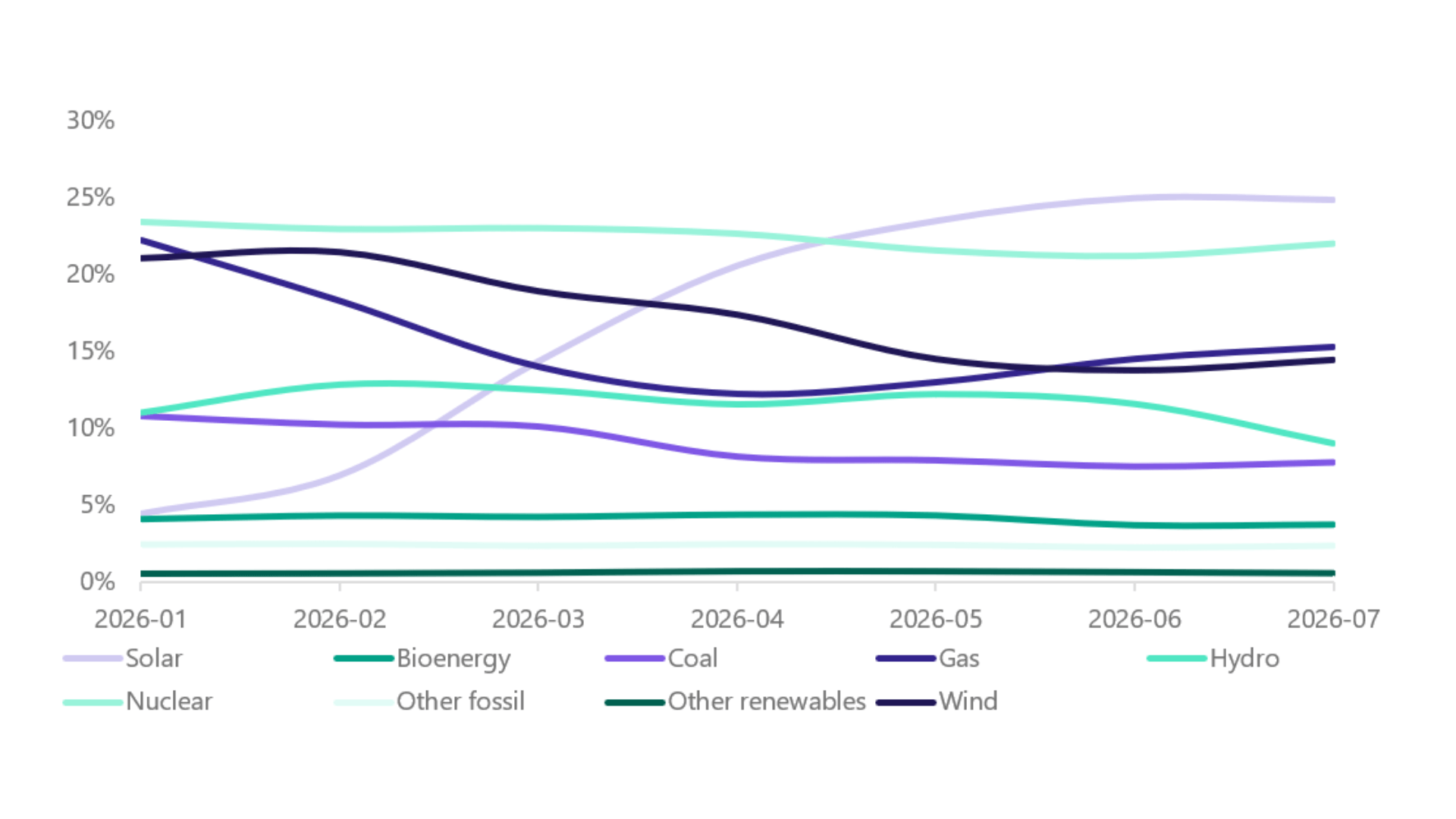
This highlights an important distinction in how different generation technologies respond to extreme heat: while conventional thermal generation can face fundamental constraints from rising temperatures and water scarcity, solar PV proves to be a resilient power source. In fact, solar, particularly when paired with battery storage, is well suited to complement air-conditioning demand, given their strong seasonal and, in many cases, daily correlation.
Historically, the focus has been narrowly on how cheaply electricity can be generated. While this question remains critical, there is also now an intense focus on how reliably infrastructure performs under a wider range of climate conditions.





The lessons from summer 2026 extend beyond generation alone. While solar proved resilient when conventional thermal assets struggled, maintaining a reliable power system will require greater flexibility across the grid. Battery storage, demand response and increased interconnection can all help absorb weather-related shocks, with battery storage particularly well suited to complement renewable generation by shifting excess daytime solar output into the evening peak and providing rapid-response capacity during periods of system stress.13
A flexible, integrated power system is also an asset in the face of growing physical threats. For example, Ukraine is diversifying its energy infrastructure into renewable technologies that are seen as more resilient in the face of Russian attacks.14
The energy transition is therefore not only about decarbonising electricity generation, but about building infrastructure capable of operating reliably in a changing climate. For investors, this creates opportunities across the energy system as while new generation capacity is essential, so are the assets that allow that generation to be integrated, stored and transported when and where it is needed.
This is reflected in the investment strategy of Foresight Energy Infrastructure Partners II (“FEIP II”), which invests across three complementary areas of the energy transition: generation, storage and transmission. Together, these assets can help address not only the challenge of adding low-carbon capacity, but the increasingly important challenge of ensuring that capacity remains usable and valuable under more volatile operating conditions.
The summer of 2026 may therefore prove to be a useful inflection point in how we think about energy infrastructure. The question is no longer simply which technologies can generate the cheapest electricity, but which combinations of assets can deliver reliable, flexible and resilient power in a changing climate.


