

Real Assets
We build future energy systems and resilient infrastructure, backing emerging opportunities in technology, land and water.


The Finance Act 2026 confirmed that most unused pension funds and death benefits will be included in the estate for IHT on deaths from 6 April 20271. For the past decade, sitting outside the estate made the pension the first pot to fund and the last to draw on. That logic now needs revisiting, but not for every client.
Paul Squirrell, Head of Retirement and Savings Development at Fidelity, points out that three groups can usually be set aside early:
The first two are easy to identify. For the third, health information and existing cashflow statements should provide the evidence. Even so, it’s worth confirming that their expression of wishes is up to date in case funds are, unexpectedly, left over.
The remaining clients tend to fall into two groups: the wealthiest, who have used the pension as a tax-efficient home for surplus wealth intended for their heirs, and those on track for a pension that may exceed their lifetime needs. For the second group, the balancing act between funding retirement and reducing a taxable surplus is a delicate one.
Within both groups, the priority is older clients, or those in poor health, facing a large new IHT liability. They may need to decumulate quickly. Everyone else can be managed incrementally.
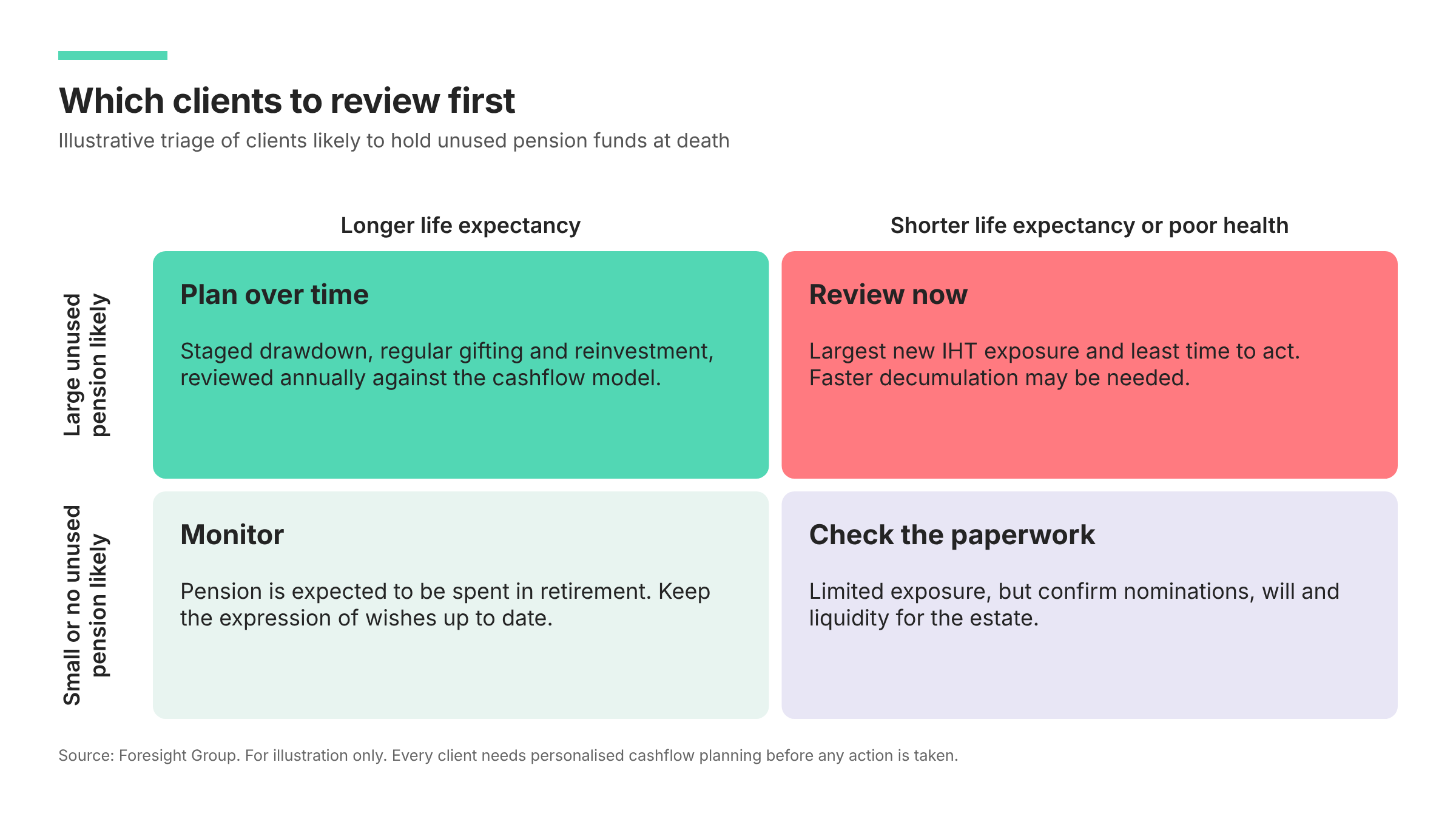
The current Retirement Living Standards put the cost of a comfortable retirement at £45,400 a year for one person and £62,700 for a couple, after tax2. On 2026/27 rates that is roughly £55,000 of gross income for an individual, or £72,000 for a couple with income split evenly. Allowing for full new State Pensions and a 4% withdrawal rate, it points to pension capital of around £1.05 million for an individual or £1.2 million for a couple.
This is a rough classification only. It assumes anyone engaged in IHT planning will want at least a comfortable retirement. Once you know which group a client sits in, personalised cashflow planning should follow.
Documents to review: Current Retirement Living Standards, retirement suitability report, latest annual review
Current age gives a starting point for how long the pension needs to last. The Office for National Statistics (ONS) figures below are averages and take no account of health3.
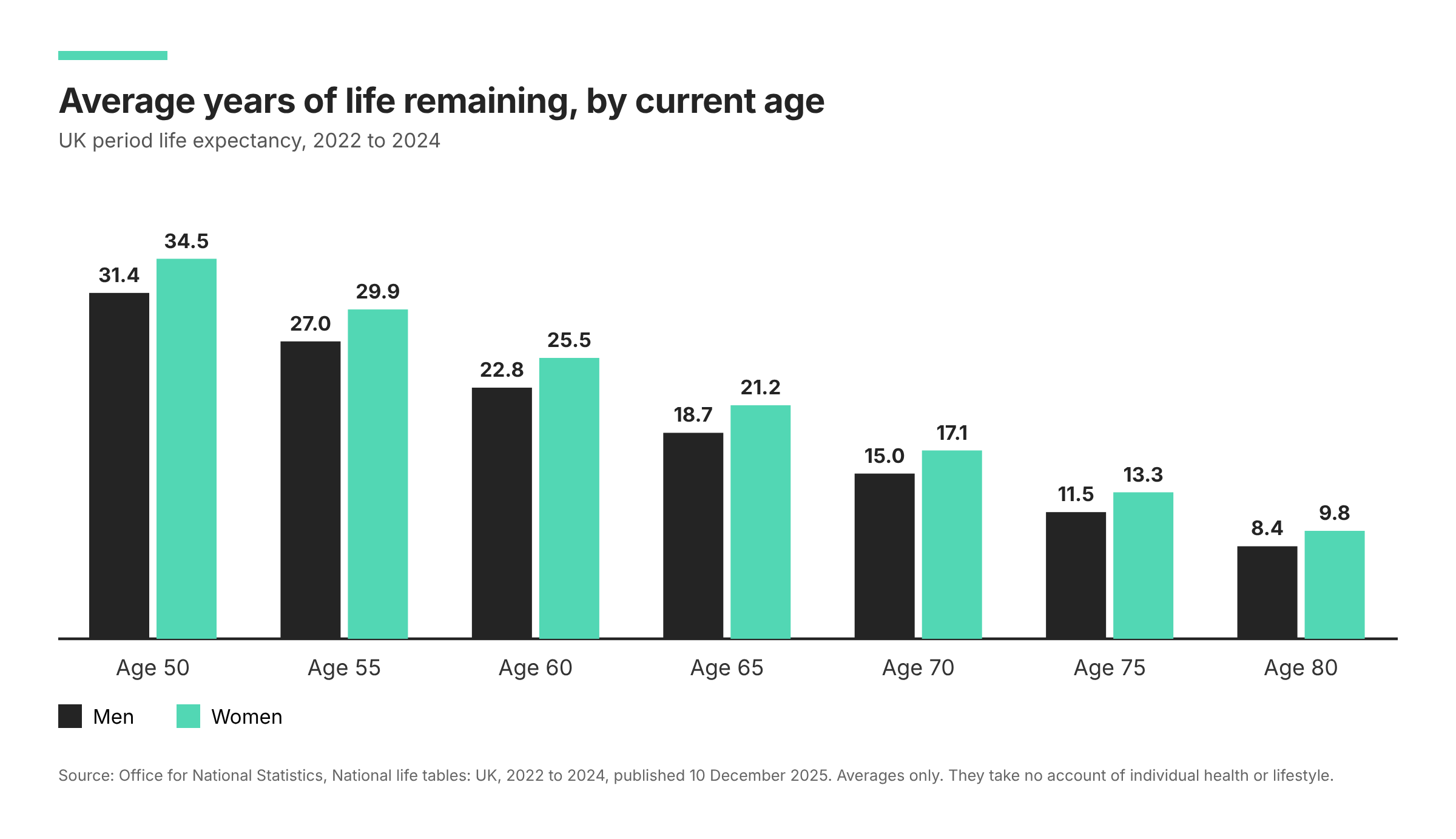
A couple will typically need less income per person than a single client, whilst any need to access the pension early will erode the capital available later. Where the pension is likely to deliver no more than a comfortable income, the case is unlikely to be urgent. Where it will comfortably exceed what the client could reasonably spend, particularly if life expectancy is short, review now.
Documents to review: Retirement income strategy, cashflow model
Next, establish where new IHT liabilities will arise. Capture every asset: the main residence and other property, business and partnership interests, savings, ISAs and other investments, trusts, life cover not written in trust, personal possessions and gifts made in the past seven years.
Set this against the available allowances: the £325,000 nil-rate band, the £175,000 residence nil-rate band and, since 6 April 2026, the £2.5 million allowance for 100% Business Relief (BR) and Agricultural Property Relief (APR), which is transferable between spouses and civil partners4. Three technical points deserve attention:
Documents to review: Fact-find, platform valuation statements, SIPP and SSAS files, trust deeds, BR and APR suitability reports, death benefit statements
Once the potential liability is known, the planning options can be considered:
Documents to review: Retirement income strategy, drawdown suitability report, cashflow model, meeting notes on gifting intentions
Documents to review: Expression of wishes, provider nomination records, will, protection policy schedules, trust deeds
No single action will resolve every case. Identifying the right clients early gives advisers the time to make considered, incremental changes rather than rushed ones.
For more support on preparing clients for the changes, or to discuss how our solutions can support your planning approach, our team is ready to help. Book a meeting with your local BDM.
1. Finance Act 2026 (Royal Assent 18 March 2026); HMRC, Inheritance Tax: unused pension funds and death benefits, 26 November 2025, gov.uk
2. Pensions UK, Retirement Living Standards, June 2026, retirementlivingstandards.org.uk
3. Office for National Statistics, National life tables: UK, 2022 to 2024, 10 December 2025, ons.gov.uk
4. HM Treasury, changes to Agricultural Property Relief and Business Relief, December 2025, gov.uk
5. Royal London, IHT: pension death benefits from April 2027, updated 29 July 2026, adviser.royallondon.com
This article is issued by Foresight Group LLP (“Foresight”) which is authorised and regulated by the Financial Conduct Authority (“FCA”) under firm reference number 198020 on [date of issue]. Foresight’s registered office is at The Shard, 32 London Bridge Street, London, SE1 9SG. This article has not been approved as a financial promotion for the purpose of Section 21 of the Financial Services and Markets Act 2000 (“FSMA”).
This article is intended for financial advisers and for information purposes only, and does not create any legally binding obligations on the part of Foresight. Without limitation, this article does not constitute an offer, an invitation to offer or a recommendation to engage in any investment activity. The information contained in this article is based on material we believe to be reliable. However, we do not represent that it is accurate, current, complete or error free. Assumptions, estimates and opinions contained in this document constitute our judgement as of the date of the document and are subject to change without notice. Opinions expressed by third parties are their own and do not necessarily reflect the views of Foresight.
BR products designed to manage tax liabilities are not suitable for all investors and will place investors’ capital at risk, and you may not get back the full amount invested. The tax scenarios shown are indicative and are subject to change. Please note that the availability of the BR tax reliefs is dependent on each investor’s individual circumstances. BR tax reliefs are subject to change, investments may also rely on the company or investment opportunity in question meeting BR qualifying criteria which are not guaranteed.
Foresight does not provide financial, legal, investment or tax advice, and therefore potential investors should seek specialist independent tax and financial advice before deciding to invest. Past performance should not be taken as a reliable indicator of future results and forecasted returns are not guaranteed. The BR products are long term investments and you may not be able to get your money back out before the end of the investment term. Please see the relevant offering documents for full details where attention should be paid to the risk factors set out.

