

Real Assets
We build future energy systems and resilient infrastructure, backing emerging opportunities in technology, land and water.

The renewed Net Zero Asset Managers initiative (NZAMi) commitment3 foregrounded fiduciary duty, client mandates and jurisdictional constraints, reflecting a more pragmatic framing amid growing political scrutiny of ESG, particularly in the US. A similar pragmatism was evident in the new UK Stewardship Code 20264, which recognised the limits of company-level engagement by emphasising “macro-stewardship” as a means for addressing the market-wide and systemic forces shaping long-term outcomes.
Climate frameworks evolved in parallel. The Science Based Targets initiative’s (SBTi) updated draft guidance5 placing greater emphasis on addressing Scope 3 emissions through value-chain engagement, signalling a shift from target-setting alone towards influencing real-economy outcomes.
Attention also turned to private markets. The new Stewardship Code, for the first time, extended expectations across private equity, infrastructure, private credit and real estate, while the UK Government’s Mansion House reforms are likely to accelerate the application of institutional stewardship expectations beyond public equities.6 A review of the 17 signatories to the Mansion House Accord7 shows that the large majority are also signatories to the UK Stewardship Code, reflecting the close overlap between institutions committing to increased investment in private markets and those subject to formal stewardship expectations. Most major pension providers and investment managers involved (including Aviva, Legal & General, M&G, Royal London, Nest, USS and Mercer) have been Stewardship Code signatories since 2021-23 indicating that the expansion of capital into private assets is likely to be accompanied by an extension of established stewardship practices beyond listed equities, in our view.
Looking inward, 2025 also marked a turning point for the WHEB Strategy as it embedded within a new home at Foresight.
The stewardship shifts of 2025 including heightened accountability, greater scrutiny of fiduciary duty and a stronger emphasis on macro‑stewardship, all reinforced a theme we explored in our 2024 white paper: effective engagement requires moving from breadth to depth.8 Last year, the integration of the WHEB Strategy within Foresight Capital Management (FCM) proved critical to strengthening that discipline.
Together, WHEB and FCM now operate from a more coherent platform that combines WHEB’s outcome‑oriented stewardship model (the ‘Stewardship Engine’) with Foresight’s broader operational capabilities, private‑markets expertise and governance structures. This integration enabled several tangible wins in 2025, directly positioning us for success in 2026, a year that will be shaped by the landscape described above.
By embedding the Stewardship Engine across FCM’s funds, we established a more structured and objective‑led approach to engagement. Clear objectives defined milestones and consistent scorecards will guide how we assess materiality and allocate stewardship resources. This has already strengthened discipline across themes such as climate, biodiversity, and diversity equity and inclusions (DEI), at a time when regulators and clients are demanding more evidence of real‑world impact.
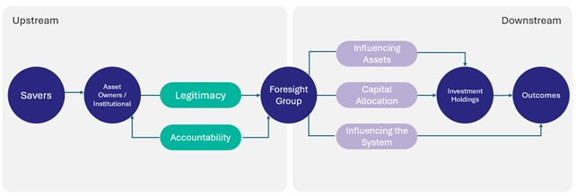
The Stewardship Engine’s foundations of legitimacy and accountability (Figure 1) align directly with the renewed focus on client mandates and fiduciary duty. In 2025, we strengthened how engagement priorities are anchored in client mandates, sustainability goals and fund‑level investment beliefs. We also remain committed to evidencing out contributions to outcomes without overstating causation. This clarity is essential in an environment where scrutiny of stewardship claims is increasing.
Figure 1. The Stewardship Engine’s foundations are based on legitimacy, accountability, influencing companies, capital allocation and influencing the system9
Foresight’s Real Assets and Private Equity teams already apply strong stewardship and governance practices. This strengthens our systemic engagement, particularly on climate and biodiversity, where scale and coordination matter.
Across 2025, we strengthened the foundations needed for effective stewardship. These improvements ensure our stewardship model is more scalable, consistent and evidence‑driven across FCM:
Our structured approach, now underpinned by Foresight’s Sustainability Accountability Framework11, has already supported a coordinated Group effort to shape policy on Renewable Obligation Certificates (ROCs):
The same forces that defined 2025, greater accountability, a more pragmatic view of fiduciary duty, and a shift toward system‑level influence, will continue to shape effective stewardship as we continue through 2026.
FCM is well‑placed to respond. We are strengthening our capability, discipline and reach through the integration of WHEB and Foresight, allowing us to focus on where we are best able to influence for long-term client value.
Building on the foundations set in 2025, and in close partnership with clients and collaborators, our focus is on delivering stewardship that is robust, consistent and fit for addressing the systemic challenges that lie ahead.
Rachael Monteiro
Stewardship and Climate Manager
Foresight Capital Management



You have viewed 0 of 0
Foresight Group LLP does not offer legal, tax, financial or investment advice and the information on this website should not be construed as such. We recommend investors seek advice from a regulated financial adviser. The opportunity described in this document may not be suitable for all investors. Any such investment decision should be made only on the basis of the Fund scheme documents and appropriate professional advice.
Foresight Group LLP acts as investment manager and is authorised and regulated by the Financial Conduct Authority with Firm Reference Number 198020 and has its registered office at The Shard, 32 London Bridge Street, London SE1 9SG.
OEICs
An investment in FP Sustainable Future Themes Fund, FP Foresight Global Real Infrastructure Fund, FP Sustainable Real Estate Securities Fund, FP UK Infrastructure Income Fund or FP WHEB Sustainability Impact Fund and Liontrust Diversified Real Assets Fund (together the “Funds”) should be considered a long-term investment that may be higher risk. Portfolio holdings are subject to change without notice.
The Authorised Corporate Directors FundRock Partners Limited (registered office at Hamilton Centre, Rodney Way, Chelmsford, England, CM1 3BY) and Liontrust Investment Partners LLP (registered office 2 Savoy Court, London WC2R 0EZ), are authorised and regulated by the Financial Conduct Authority with Firm Reference Numbers 469278 and 518552 respectively. The Funds are incorporated in England and Wales.
ICAVs
An investment in the WHEB Sustainable Impact Fund and the WHEB Environmental Impact Fund (together the “Funds”) should be considered a longer-term investment that may be higher risk. Portfolio holdings are subject to change without notice.
The Manager of the Funds is FundRock Management Company S.A., authorised and regulated by the Luxembourg regulator to act as UCITS management company and has its registered office at Airport Center Building, 5, Heienhaff, L-1736 Senningerberg, Luxembourg.
We respect your privacy and are committed to protecting your personal data. If you would like to find out more about the measures, we take in processing your personal information, please refer to our privacy policy, which can be found at http://www.foresight.group/privacy-policy.


