

Real Assets
We build future energy systems and resilient infrastructure, backing emerging opportunities in technology, land and water.


Technology
Deep Tech
2022
Initial investment date
Venture Capital
Investment type
Lia: Our vision is to deliver autonomous motion sensing you can trust. Today’s systems like robots, cars and drones rely on cameras, GPS and maps, which can fail when conditions change or signals are unavailable. Inertial sensors are the solution, but mass-market inertial sensing has seen very little fundamental change for decades. We’re redefining inertial sensors by removing the inaccurate component and inserting something new, based on fundamental physics but also scalable to billions of units per year.
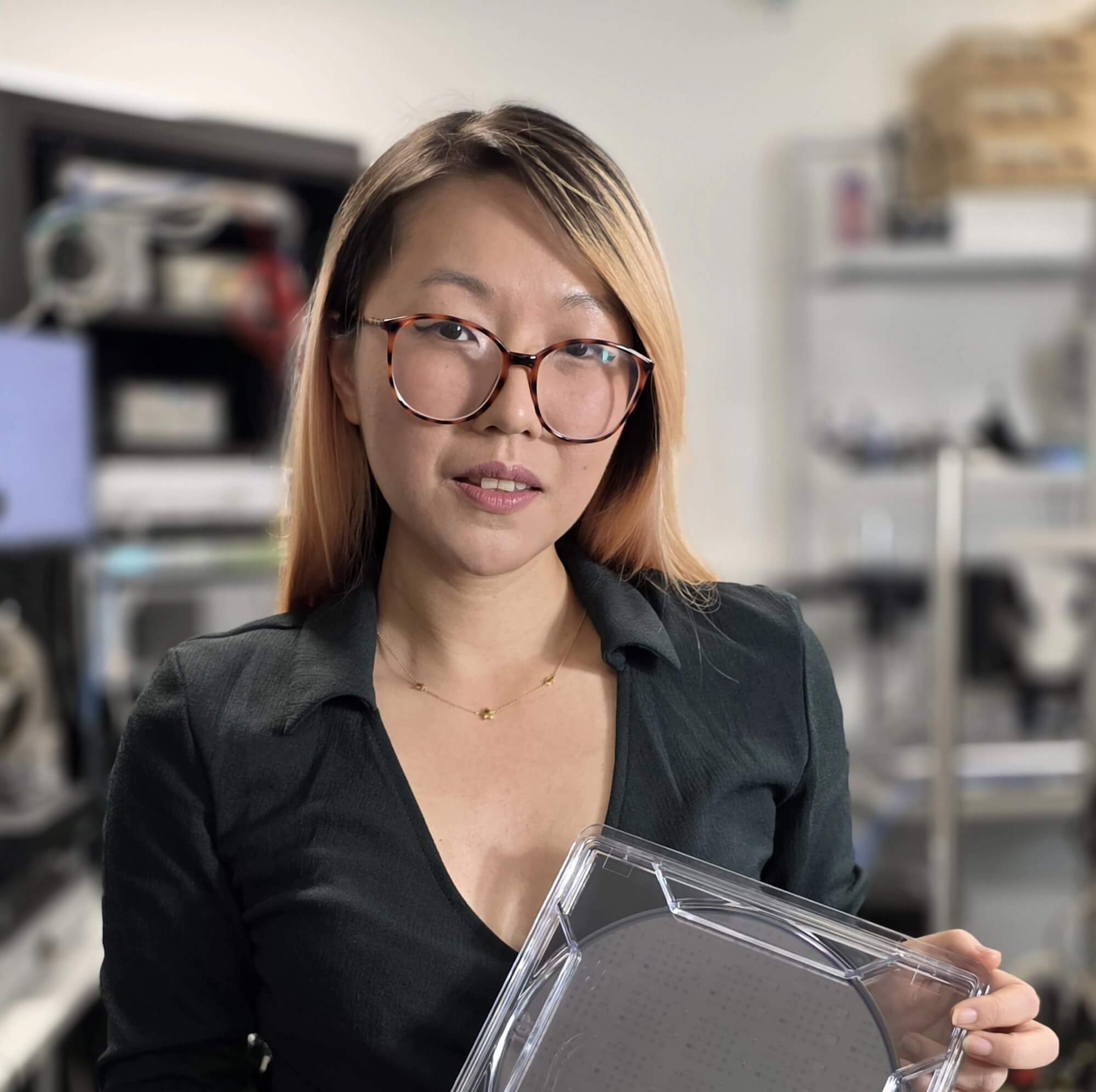
To break this into milestones, we had to bring together two semiconductor worlds that have traditionally been separate: MEMS and silicon photonics.. That meant choosing the right foundries and using multiple facilities, taking the best of each. Today, we are proving the platform is manufacturable and are in a fast-iteration phase - focused on repeatability and product readiness.
Lia: The foundries are the most important part of our supply chain, so we spent a lot of time finding the right partners. We visited different sites, looked at the machines, the customers, the devices they produce and thought carefully about long-term alignment. We expect to work with these partners for over a decade, so a shared vision matters. We meet every week and they feel like part of our team, rather than a traditional supplier relationship.
There have also been some key people along the way who have shaped this journey and a collection of experiences that have shaped how I view the trajectory of the business. I worked at BAE Systems, where I learned how to operate the machines that build sensors like this. My background in photonics came from research but the MEMS (micro-electro-mechanical systems) and semiconductor experience came from industry. My mentor, Ian Sterland, has been particularly important, he has supported the company from the beginning and now comes into the office frequently and joins meetings with our foundry partners. Having someone who understands both the technical detail and how to scale it in practice, while also providing support, has made a real difference.
On the business side, receiving an Innovate UK Women in Innovation Award early on was an incredible honour and opened access to contacts and support from Innovate UK and their advisors. That made it easier to build relationships with the right people and get momentum in the early stages.
Lia: With Foresight Group, Chris Wiles, one of our directors, has connections across hardware deep tech companies, which not all investors have. Many VCs are more software-focused, but Foresight’s portfolio includes a range of deep tech businesses, so there’s shared learning across the group which we benefit from.
We’ve been connected with companies like VividQ, Opsydia and Phlux, and there’s always a steady flow of “you should talk to this person” or “this CEO went through something similar”. Those conversations are genuinely helpful because they come with context and shared experience, and they’re easier to have when there’s an existing relationship through a shared investor, particularly at our stage of growth.
Another investor, Verve Ventures brings a similar benefit from a European perspective, particularly with connections into robotics and deep tech. That UK–Europe link is valuable when you’re building across multiple disciplines. Finally, when u-blox - a leading company in the positioning and wireless communications market - invested in us, it gave us a strong link to a technology partner that understands customers and markets. They ship hundreds of millions of GPS chips each year, so having that validation early on was meaningful.
Lia: Absolutely. Five to ten years ago, dual-use technologies were often seen as a risk, partly because of uncertainty around demand and how to navigate it. Today, the conversation is more nuanced, particularly as defence-driven demand has become more visible.
Many investors now recognise resilient navigation and sensing as foundational technologies, especially for robotics, autonomy and physical AI. At the same time, there are still important considerations around export control, customer selection and long-term positioning. For us, the important point is that the underlying technology is not defence-specific. The same need for trustworthy physical-world data exists across drones, robotics, industrial autonomy, vehicles and eventually wearables. As intelligence moves out of computers and into the physical world, sensing becomes increasingly fundamental.
Defence is an important early market because the consequences of poor sensing are immediate, so it gives us a demanding environment in which to prove the technology. But the platform is being built for much broader physical AI markets.
Lia: It’s a bit of both, and a good reflection of what life in a deep tech start-up is like. It can feel very David and Goliath at times! Supply chains in particular have been a challenge for us. We’ve had components stuck at customs for weeks when tariffs were changing, worsened when we were deprioritised in favour of larger customers. When you’re iterating quickly, those delays have a real impact because you lose momentum and learning cycles.
You can’t always solve that with capital, so we’ve had to be creative. We’ve built in optionality through second sourcing and revisiting foundry relationships, and we’ve brought more capability in-house, from testing and measurements to assembly work, which helps us keep moving and learn faster.
We’ve also built key relationships with local universities, working closely with them to access equipment and expertise where needed. These partnerships aren’t always perfect but they help us maintain momentum and those collaborations are valued. They also provide a valuable pipeline into emerging talent, giving us a natural link to the next generation of engineers and entrepreneurs. In some ways, being smaller forces you to think differently but that’s also where a lot of the innovation comes from.
Lia: We use an internal analogy of “mothership versus explorer”. The mothership is a large, stable, process-driven organisation. Explorer is a small team operating in uncertainty. We often say we are the explorer, a small team figuring things out in real time. It’s a helpful way to explain the pace, the ambiguity and the nature of the work.
We operate at the intersection of photonics, semiconductors, electronics, software and hardware and there isn’t an existing talent pool for that. That’s shaped how we hire and how we operate.
One of the biggest lessons has been to be upfront about that from the start. Explorer mode isn’t something we can switch off until we have scale and stability and to some extent, we will always be explorers. We’re selective in hiring because the work is complex, but we focus less on experience and more on how quickly someone can learn and adapt. People who are curious, motivated and willing to take ownership tend to do well.
But also, there needs to be balance. The work is stretching, but it shouldn’t feel unsupported. A lot of that comes down to communication. We rely heavily on asynchronous communication, which allows us to move quickly without unnecessary meetings. It keeps everyone aligned and makes it easier to solve problems as they arise.
Culturally, we’re trying to build the kind of company I wish existed when I was younger. I grew up wishing I could have been there when the first transistors or integrated circuits were being built. That sense that you are early enough to help create a new technology category, rather than simply improve an existing product, is what we want people here to feel. It’s difficult work, but that is also what makes it exciting.


You have viewed 0 of 0

